
2005년 5월 27일 거제도 포로 수용소 유족공원에 건립된 응남철수 기면비 앞에 선 로버트 러니 씨와 현봉학 박사, 로버트 러니는 흥남철수 때 1만 4천명을 피란시킨 메러디스 빅토리호의 상급선원 이었다. 5월 27일 포로수용소는 노인들로 북적 거렸다. 당시 응남부두를 빽빽하게 메우고 서 있던 주인공 들 이었다. 거제도는 흥남부두를 떠난 10만여명의 피란민들이 첫발을 내디딘 곳이다. 양승호 씨도 그 중 한명 이다.
" 1950년 12월 24일 , 1000명의 피란민과 함께 거제도 장승포항에 도착했습니다. 우리가 탄 배가 피란민을 실은 첫 배 같았습니다. 장승포 경찰서에서는 피란민들을 어디에 어떻게 수용해야 할지 몰라 당황했습니다. 경찰은 일단 우리를 인근 국민학교 교실에 배치 했어요. 이북에서 나온 사람들이라고 경찰이 경비를 서더군요. 그런데 다음날 부터 피란민을 실은 배가 막 쏟아져 들어오자, 경찰들이 경비고 뭐고 , '알아서 다른 곳에 가서 살아라' 합디다. "
장승포에 살고 있는 윤말순 할머니는 부두에 내리는 북한 피란민들에게 주먹밥을 나눠 줬다. 배에서 내린 피란민들은 3일 동안 물 한 모금 먹지 못한 상태였다. " 피란민들이 탄 배가 도착하면 주먹밥을 해서 광주리에 담아 머리에 이고 부두로 나갔지, 피란민들은 한 손에는 보따리를 들고, 다른 손에는 우리가 주는 주먹밥을 먹으면서 부두를 죽 빠져 나오드만 "
당시 인구 10만의 거제도에 피란민 15만명을 수용했다. 거제도에 도착한 피란민들은 주민들의 신세를 져야 했다. 그때 일을 기억하는거제도 노인들은 " 골방이나 창고에 까지 피란민들이 들어 찼지만 누구 하나 불평하는 사람이 없었다."
방을 구하지 못한 사람들은 마을 어귀 공터나 산에 움막을 치고 살았다. 당시 거제 인구는 10만명, 피란민이 15만영 이상이었다. 흥남철수작전으로 온 10만여명 의 피란민 외에 부산에 머물던 피란민 상당수가 거제도로 옮겨졌다.
양식이 배급되었지만 대부분은 돈이 없었다. 산에서 나무를 해서 팔거나 막노동을 했다. 포로는 상대로 장사를 해서 돈을 버는 피란민도 있었다. 포로수용소 철조망 너머로 먹을 것을 넘겨주면 포로들은 옷가지나 모포를 던져 주었다. 피란민들은 포로를 표시하는 PW 라는 글씨를 지우고, 국방색을 탈색 한 후 시장에 내다 팔았다. 피란민들이 많이 머문 장승포항, 옥포항, 고현항으 부두는 좌판을 벌인 피란민들로 가득했다. 당시 거제도에서는 장승포 항이 가장 번화했다. 피란민들은 부두에 나와 쌀, 고무신, 광목 장사를 하거나, 솥을 걸어 놓고 국밥, 국수 등을 팔았다.
피란민들은 거제도에 짧게는 3개월, 보통 1~3년 정도 머물렀다. 거제도를 빠져 나간 이들은 부산에 나가 막노동을 하거나, 전국에 흩어져서 구두닦이, 식당일, 공사판 노동일 등을 닥치는 대로 했다.
거제도는 오색바위, 양지암, 신선대, 바람의 언덕 등 푸르른 바다와 함께 빼어난 바위와 어우러진 볼거리가 많은 곳이다. 흑진주 같은 검은 몽돌의 학동 해변 주변에는 동백림 군락지가 있다. 학동의 남쪽은 도장포 마을이 있는데 유람선을 탈수 있는 곳이다. 유람선 매표소 보이는 곳에
`바람의 언덕` 이 있다. 그냥 잔디밭으로 이루어진 민둥산인데 방목된 염소들이 살던 곳이다. 이후 드라마 촬영지로 소개 되면서 관광지가 되었다. 탁 트인 바다전망이 좋아서 사람들의 입소문으로 `바람의 언덕` 이라 불리게 된다.
해금강은 1971년 3월에 명승 제2호로 지정 되었으며, 거제도 최남부의 갈곶과 작은 돌섬인 갈도 일대는 기암괴석이 하늘로 치솟아 장관이다. 그 모양이 만물상을 이루고 있으며 모습이 금강산의 해금강을 방불케 하여 `거제 해금강` 이라 불러 왔다. 갈도는 약초가 많아서 약초섬이라 하는데 아열대 식물 30여종이 분포하고 있다. 바닷물이 빠졌을때 해금강의 신비로운 모습을 자세하게 볼 수 있는데 십자동굴과 석문, 사통굴, 부처바위, 금관바위, 촛대바위, 조서방바위 등 수많은 바위들을 둘러 볼수 있다. 해금강은 중국의 진시황이 불로장생초를 구하도록 보낸 `서불` 과 남자아이와 여자 아이 3천명이 불로초를 함께 찾았다는 `서불과차` 라는 글씨가 새겨져 있을 정도로 약초가 많다 하여 `약초섬` 이라 불렸다.
외도는 한국의 파라다이스로 불리며 천연 동백숲과 아열대식물 3천 종의 수목을 만날수 있는 곳이다. 외도로 가는 선착장은 6곳이며 거리에 따라 요금이 다르다.
가는 곳 마다 신비한 모습과 자연을 그대로 간직한 곳이 한두 군데가 아니다. 교통이 좋아서 하루 만에 볼수는 있지만 아쉽다. 약 이틀 정도는 다녀야 한다.
On May 27, 2005, Robert Lunney and Dr. Hyun Bong-hak stood before the monument honoring the “Heungnam Evacuation and the Meredith Victory” built in the Geoje Prisoner-of-War (POW) Camp Memorial Park. Robert Lunney had been a senior crew member aboard the SS Meredith Victory, the ship that rescued 14,000 refugees during the Heungnam Evacuation. On that May day, the former POW camp was crowded with elderly people — the very same individuals who had once filled the Heungnam port as they fled the war. Geoje Island was the first place where over 100,000 evacuees from Heungnam set foot after escaping the North.
Among them was Mr. Yang Seung-ho.
> “On December 24, 1950, I arrived at Jangseungpo Port on Geoje Island with about 1,000 other refugees. I think our ship was the very first one carrying evacuees to reach Geoje. The Jangseungpo police didn’t know how or where to accommodate us and seemed at a loss. They decided to place us in nearby elementary school classrooms. Because we were people from the North, policemen even stood guard. But the very next day, when more and more ships full of refugees began to pour in, the police gave up and said, ‘You’ll have to find somewhere to live on your own.’”
Grandmother Yoon Mal-sun, who lived in Jangseungpo, handed out rice balls to the starving refugees as they arrived at the pier. The evacuees had not had a drop of water for three days.
> “When the ships arrived, I would make rice balls, put them in a basket, carry them on my head, and go down to the dock. The refugees would walk off the ships, carrying their bundles in one hand and eating the rice balls we gave them with the other.”
At that time, Geoje Island — with a population of about 100,000 — took in around 150,000 refugees. Those who arrived depended heavily on the kindness of local residents. Elderly islanders who remember those days say,
> “Every attic and storage room was packed with refugees, but not a single person complained.”
Those unable to find a room built makeshift shelters in empty lots or in the mountains. The population of Geoje then was about 100,000, and more than 150,000 refugees were added. In addition to the 100,000 evacuees from the Heungnam evacuation, many refugees who had been staying in Busan later moved to Geoje Island.
Food rations were distributed, but few had money. Most made a living by chopping firewood to sell or by doing manual labor. Some refugees earned money by trading with POWs. They would hand food over the barbed-wire fences of the POW camp, and in return, the prisoners would throw back clothes or blankets. The refugees erased the letters “PW” that marked the prisoners’ clothing, bleached the army-green fabric, and sold it in the markets.
The ports of Jangseungpo, Okpo, and Gohyeon were crowded with refugees setting up makeshift stalls. Among them, Jangseungpo Port was the busiest. Refugees sold rice, rubber shoes, and cotton cloth, or cooked and sold dishes such as soup and noodles right by the pier.
The refugees stayed on Geoje for as little as three months, though most remained between one and three years. Those who left later went to Busan to find labor jobs or scattered across the country, doing whatever work they could find — shining shoes, washing dishes, or working at construction sites.
Geoje Island is known for its stunning scenery — the deep blue sea set against striking rock formations such as Osaekbawi, Yangjiam, Sinseondae, and Windy Hill (Baram-ui Eondeok). Around Hakdong Mongdol Beach, famous for its black pebble shoreline that glistens like black pearls, lies a dense camellia forest.
South of Hakdong is Dojangpo Village, where visitors can board sightseeing boats. Across from the ticket office stands Windy Hill, a bare grassy knoll once home to grazing goats. After it was featured as a TV drama filming location, it became a popular tourist spot. With its open view of the sea, people began calling it “Windy Hill.”
Haegeumgang, designated Scenic Site No. 2 in March 1971, lies off the southern tip of Geoje between Galgot Cape and the small rocky islet of Galdo. Towering rock cliffs form a spectacular sight resembling the famous Haegeumgang on Mt. Geumgang. Because Galdo is rich in medicinal herbs and subtropical plants (about 30 species), it is also called “Herb Island.”
When the tide recedes, one can explore Haegeumgang’s mysterious formations up close — the Cross Cave, Stone Gate, Four-Way Cave, Buddha Rock, Crown Rock, Candlestick Rock, and Joseobang Rock. The island’s name also relates to the legend of “Seo Bul,” the envoy of China’s First Emperor Qin Shi Huang, who was sent to find the elixir of immortality. The inscription “Seo Bul-gwa-cha (Seo Bul Passed Here)” remains carved into the rock, suggesting the island’s ancient reputation as a source of medicinal herbs.
Oedo, often called “the paradise of Korea,” is home to a natural camellia forest and more than 3,000 species of subtropical plants. There are six ports from which visitors can take a ferry to Oedo, with fares varying by distance.
Each place on Geoje holds its own mysterious beauty and unspoiled nature. While one could tour the island in a single day thanks to good transportation, it is best enjoyed over two days to fully appreciate its charm.
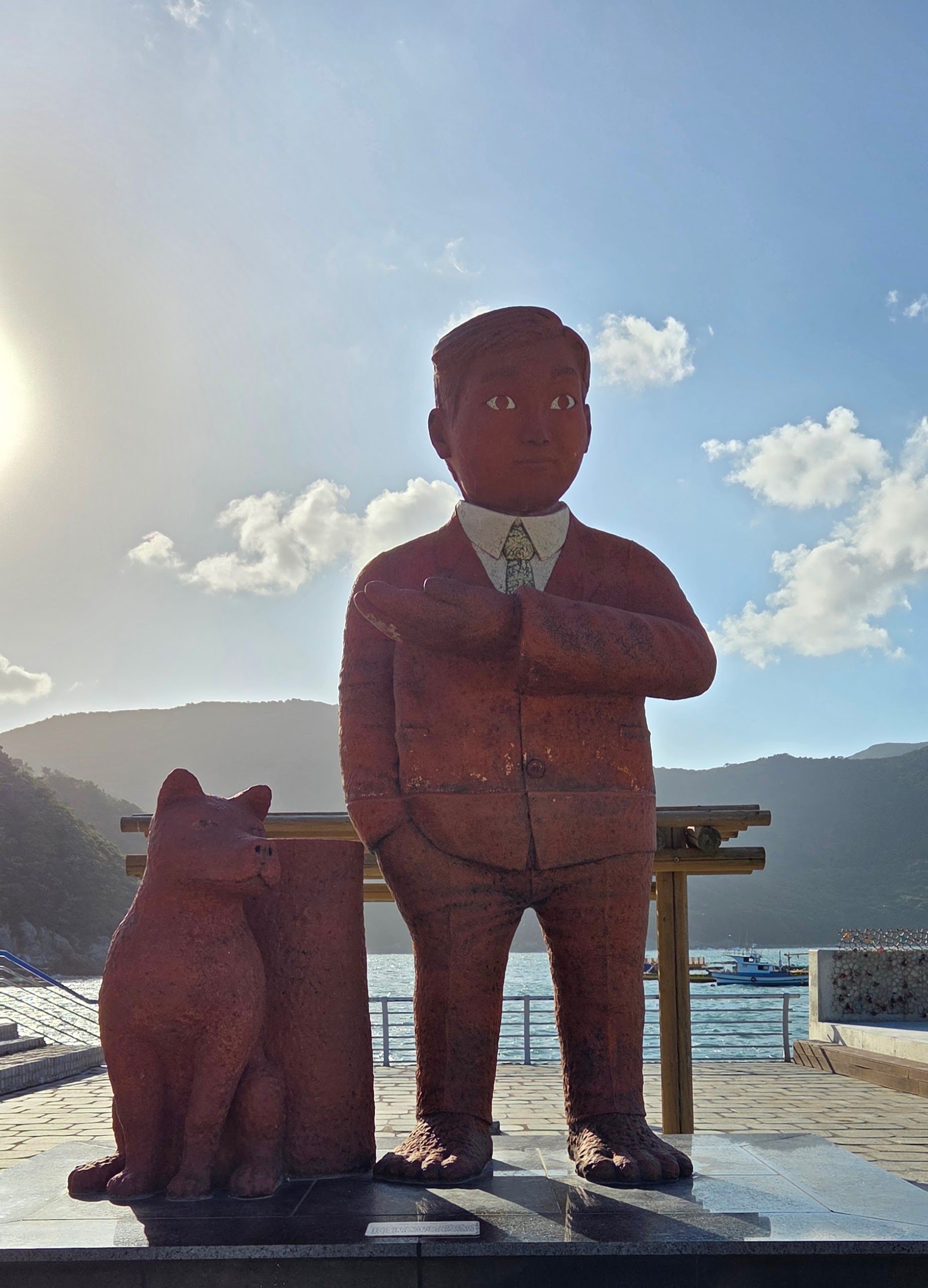
이재준 작가의 대표작 `Guardian of the Nature' 자연을 상징하는 개와 인류를 의미하는 인간 , 바람의 언덕 아래
'밥벌이Livelihood' 카테고리의 다른 글
| 나전칠기(1) "Najeon chilgi (mother-of-pearl lacquerware)" (1) | 2025.11.22 |
|---|---|
| 거제 외도 Geoje Waedo (1) | 2025.10.12 |
| 거제도 Geoje Island(1) (0) | 2025.10.12 |
| 아라한 Arahan (0) | 2025.10.09 |
| 성덕대왕 신종 성분 분석 Composition Analysis of the Sacred Bell of King Seongdeok (0) | 2025.05.01 |